Crazy Moto review
A 2D motorbike stunt game with 22 levels of loops, barrels and collapsing platforms, timed three-star ratings and flips that feed a score. Keyboard is best.
Crazy Moto
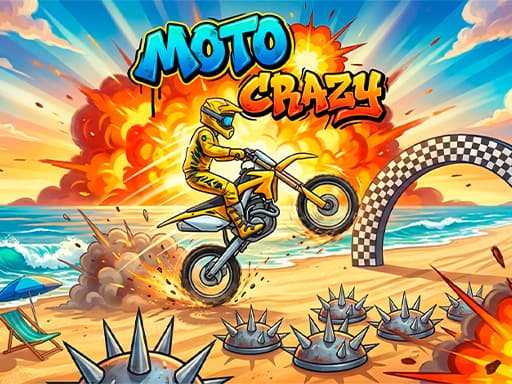
Loads the game in this frame. Nothing is installed; the game runs in your browser tab.
The game is made by its developer and served through its distributor, GameMonetize. It may show its own adverts inside the frame. Read our editorial policy for how we choose what to list.
Controls
Keyboard & mouse
- Up arrow or W to accelerate
- Down arrow or S to brake and reverse
- Left/Right or A/D to shift the rider's weight for flips
Phone & tablet
- On-screen gas and brake pedals
- Gas and brake also rotate the bike in the air
- No separate lean buttons
What it is
Crazy Moto is a side-on motorbike game where the bike is a physics object and you are steering a pair of forces: throttle at the rear wheel and the rider's weight forward or back. The 22 levels are hand-built rather than generated, and they lean into hazard design: loops, exploding barrels, spikes, platforms that give way under you and drops with no floor. Every level is against a clock, with up to three stars for finishing quickly.
There is a trick layer on top. Front flips, back flips, double flips and wheelies all count towards a score, and the game names those four moves. Stars are the currency: they unlock new bikes, three of which the developer names (a Firehead, a Martian and a Desert Racer), and each is meant to handle differently. That makes the star rating more than a badge; it is what stands between you and the next bike.
How it plays
Keyboard first. Up or W opens the throttle, Down or S brakes and then reverses, and the left and right keys shift the rider's weight, which is how you rotate in the air and how you stop the bike from looping when you accelerate hard on a climb. In 2D bike physics, throttle alone pitches the front wheel up, so the lean-forward key is doing constant work on steep sections, and a wheelie is simply a controlled version of the same effect.
On a phone the developer has replaced the lean keys with the pedals themselves: gas and brake double as rotation while the wheels are off the ground. That is a common compromise and it works, but it couples two things you sometimes want separately, because you cannot hold the throttle for a landing while also leaning back. Expect the keyboard to be the better way to chase three stars.
Tips that actually help
Most restarts in this kind of game come from two errors: too much throttle on take-off and rotating too late. The following habits fix both.
- Land with the wheels matched to the slope, not level with the screen. A downslope landing wants the nose pointed down; landing flat on a slope means the rear wheel hits first and you bounce.
- Start a flip the instant you leave the ramp and use the whole arc. If you begin rotating at the peak you will land mid-rotation and crash.
- A double flip needs more height or a longer float, not a faster lean. Find the ramps that give you both before you try one.
- Hold the throttle through a landing. A driven rear wheel straightens the bike on touchdown; a coasting wheel lets the front dig in.
- Barrels and spikes tend to sit where a full-throttle run would land. Read a level once at half speed, then go for time.
- Wheelies are free points on flat sections if you feather the throttle and tap forward-lean to hold the angle. Do not attempt them near a drop.
The star economy
Because stars unlock bikes, the level structure has a second layer. You can push through the 22 levels collecting one star each, or replay early levels for the full three to buy a bike sooner. The early levels are the cheapest source of stars, since their times are the easiest to beat, and a different bike may suit a later level's ramps better than the one you started on. If a timer feels out of reach, try switching bikes before you sink an hour into attempts.
Where it falls short
The mobile scheme merges lean and throttle, and on the levels with collapsing platforms that costs you. Twenty-two levels is a decent number for this genre, but the three-star times are where the length is, and if you are not interested in chasing them the game is shorter than it looks. Progress is stored in the browser, so your stars stay on one device. Finally, the hazards reward memorisation, so first attempts will end in a blown-up bike more often than skill alone would suggest.
What works
- Well-defined trick set with four named moves
- Three-star timers give levels a second purpose
- Stars unlock named bikes
- Precise keyboard lean controls
What holds it back
- Mobile controls merge lean and throttle
- Hazards depend on memorisation
- Progress stays in one browser
Verdict
4.0Crazy Moto is a solid 2D bike game with enough structure that finishing a level is only the start of it. If you enjoy chasing a timer and can play on a keyboard, it is a good hour or two. Phone players will find it playable but less precise, and anyone who dislikes trial-and-error hazards should look elsewhere.
Questions people ask
- How do I do a backflip in Crazy Moto?
- Leave a ramp with speed, then hold the lean-back input through a full rotation. Start immediately on take-off and stop rotating a little before you land so the wheels meet the ground.
- Does it save my stars and bikes?
- Yes, in the browser's local storage. They stay on the device and browser you played on, so they will not appear on a second device.
- Is Crazy Moto playable on a phone?
- Yes. The gas and brake pedals are on screen and they also rotate the bike when it is airborne. It works, but flips are easier with separate lean keys on a keyboard.
- How many levels and bikes are there?
- Twenty-two levels, each with a timer and up to three stars. Stars buy bikes; three of the unlockable machines are named by the developer (a Firehead, a Martian and a Desert Racer).
If you liked this, try
 Racing
Monsters Wheels 2
4.0A side-view monster truck game with 24 events across four settings, three trucks to upgrade and a mix of races, car-crushing and backflip challenges.
Read the review → Racing
Motorcycle Stunt Racing 2025
3.5A Unity WebGL bike racer with a trick system, traffic and weather, plus Career, Trick Attack, Time Trial and an 8-player online mode, all driven with WASD.
Read the review → Racing
Mega Ramp Car Stunt Racing
3.0A 3D stunt driving game of huge ramps, basketball hoops and moving targets in muscle and super cars, with nitro. Loosely structured and keyboard only.
Read the review → Arcade
Neon Ball Slope
3.5An endless neon 3D slope game: steer a glowing ball down a track that gets steeper and faster, with coins, XP, gear, missions and daily leaderboards on top.
Read the review →Guides that mention this game
- explainer
How we review browser games
The exact process behind every review on this site: where the games come from, what gets one rejected, what each section means and how a rating is decided.
- how-to
Playing browser games on a Chromebook: what runs well and what to skip.
Chromebooks run the same Chrome as a desktop, so HTML5 games just work. Where 3D WebGL games stutter and why, plus which reviewed games suit the hardware.
- list
Nine browser games that fit a ten-minute break.
Nine reviewed games chosen for round length, quick starts and how easily you can stop: minesweeper, 2048, solitaire, ping pong, mini golf and more.