Mini Tennis 3D review
A portrait, one-tap tennis rally game where the ball gets faster the longer you last. Reflex timing and a high score to chase, not sets and games.
Mini Tennis 3D
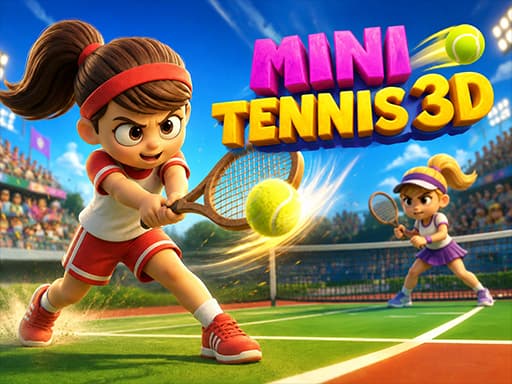
Loads the game in this frame. Nothing is installed; the game runs in your browser tab.
The game is made by its developer and served through its distributor, GameMonetize. It may show its own adverts inside the frame. Read our editorial policy for how we choose what to list.
Controls
Keyboard & mouse
- Click to swing
- Timing is the whole input; there is no aiming
- Mouse for menus
Phone & tablet
- Tap to return the ball
- One thumb, phone held upright
- Tap timing decides the return
What it is
Mini Tennis 3D is tennis reduced to a single decision: when to hit. The developer describes it as a rally game where you return shots and keep the ball in play as it speeds up, with high scores as the goal. There is no mention of sets, games, serving or a named opponent, so this is a score chaser in a tennis costume rather than a match, and it should be judged as one. The canvas is taller than it is wide, which tells you the intended device before you read a word: this is a phone game held in one hand.
Reflex rally games live or die on their difficulty ramp. Too gentle and they are dull; too steep and every run ends at the same wall. The developer says the game gets faster as the rally continues, which is the standard design, and the open question is how quickly the timing window shrinks with it.
How it plays
One input, click or tap, and the whole game is in the timing of it. In a 3D perspective the ball travels towards you, so the cue for when to hit is depth rather than position, and that is harder to read than a flat paddle game. 3D rally games generally give you a depth cue, the bounce or a shadow; find whatever this one offers in the first few rallies, because your eyes will otherwise fixate on the racket, which is the wrong thing to watch.
As the speed climbs, the window for a good return closes and the game becomes a rhythm exercise: the interval between bounce and hit shortens, and you are trying to internalise a beat that keeps changing. That is the same skill as a music game, and players who are good at those will be good at this.
Tips that actually help
Tennis rally games reward the same handful of habits as any timing game.
- Watch the ball, not your player. The swing animation follows your input; the ball's position is the truth.
- Find the depth cue early. The bounce is usually the reliable one: count the beat from bounce to hit and reproduce it.
- Tap, do not hold. A held press does nothing extra and delays your next input.
- When the rally speeds up, start your tap fractionally before you think the ball arrives rather than trying to react faster.
- Play in short bursts. Reflex games degrade quickly when you are tired, and a bad run after a good one is usually fatigue, not the game.
- Hold the phone so your thumb rests over the tap zone without stretching; a reach adds milliseconds you do not have at speed.
The difficulty ramp
The developer promises the rally speeds up and the challenge grows, which is how every one of these games works, and the make-or-break question is whether the ramp is gradual enough to feel earned or so steep that all runs end at the same score. I cannot tell you the shape without a verified play, but I can tell you what to look for: if your scores climb steadily over several tries, the ramp is fair; if they cluster at one number, the game has a wall, and your ceiling is your reaction time, not your skill.
Where it falls short
There is one thing to do. No modes, no second player, no opponent to outthink; the description mentions nothing but returning shots and chasing a score. The portrait layout is right for a phone and awkward on a desktop, where the play area will sit in a narrow strip in the middle of a wide screen. And there is no stated way progress is kept, so a high score is a personal note in this browser, not a leaderboard.
What works
- One-thumb control fits a phone held upright
- Rallies are short and the restart is quick
- Timing skill transfers from music games
What holds it back
- Single mode, single player
- Awkward on a wide desktop screen
- Ceiling is reaction time, not strategy
Verdict
3.0Mini Tennis 3D is a competent reflex toy: tap when the ball arrives, watch it get faster, try to beat your number. It is a phone game first and does its job for a two-minute wait. Skip it if you want tennis with points, opponents or tactics, because there are none, and skip it on a desktop, where the portrait canvas wastes most of the screen.
Questions people ask
- Is it a real tennis match?
- No. The developer describes a rally: you return shots and keep going as the speed rises. There are no sets, games or serving described.
- Does it work on a computer?
- Yes, with a mouse click in place of a tap, but the tall portrait canvas is designed for a phone and will look narrow on a monitor.
- Is there a two-player mode?
- No. It is single-player against the game's own returns.
- Is my high score kept?
- The developer mentions high scores but not how they are stored. Assume they live in this browser, on this device.
If you liked this, try
 Sports
Neon Ping Pong
3.0A Pong-style paddle game in neon with a computer opponent that ramps up, local two-player on one screen, and settings for paddle size and a ball speed cap.
Read the review → Arcade
Stack Ball Run 3D
3.0An endless 3D lane runner where you sweep left and right to gather balls into a tall stack and steer it round obstacles. Simple, quick and thin.
Read the review → Arcade
Tall Man Run 3D
2.5A gate runner: steer a figure through gates that make him taller, wider, thinner or shorter, dodge obstacles, and arrive big enough for the boss at the end.
Read the review → Sports
Basketball League
4.02D arcade basketball in 1v1 or 2v2 form, with a CPU ladder of Bronze, Silver and Gold Cups and proper local two-player on one keyboard.
Read the review →