Neon Mini Golf review
A 39-hole browser mini golf with synthwave looks, drag-and-release putting, and bumpers, walls and teleporters in the way. Stars unlock the later holes.
Neon Mini Golf
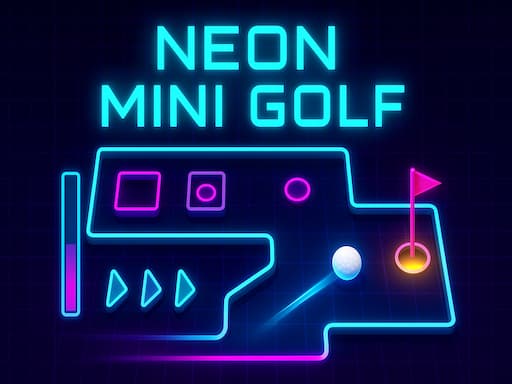
Loads the game in this frame. Nothing is installed; the game runs in your browser tab.
The game is made by its developer and served through its distributor, GameMonetize. It may show its own adverts inside the frame. Read our editorial policy for how we choose what to list.
Controls
Keyboard & mouse
- Click and drag on the ball to set the line and power
- Release to putt
- Mouse for menus and level select
Phone & tablet
- Touch and drag to aim
- Lift your finger to putt
- Same drag scheme on phones and tablets
What it is
Mini golf is a physics puzzle wearing a sport's clothes. A hole is a small course, you are given a ball, and the score that matters is how few strokes you took. Neon Mini Golf is a straight take on that idea with a 1980s-arcade coat of paint: glowing edges on everything, a dark background and a colour scheme this site can hardly object to. There are 39 holes, each built by hand rather than generated, and the developer lists three kinds of obstacle: walls that block or redirect, bumpers that fling the ball, and teleporters that move it somewhere else on the course.
Progress is tied to stars. You earn them per hole and they open up the rest of the set, which gives every hole two goals: get it in, then get it in cleanly.
How it plays
The control is a single drag. You pull on the ball to set a direction and a strength, then release. That is the right input for this game on both mouse and finger, and the developer states it runs on desktop and mobile. On a mouse the drag gives fine control over the angle; on a phone the line is coarser, but a mini golf hole forgives a degree here or there in a way a pool shot does not.
The skill is entirely in reading power against the layout. A wall bounce needs enough speed to reach the wall and still arrive; a bumper adds energy you have to account for; a teleporter changes where you exit, so the shot before it is really two shots planned together. Later holes, I would expect, stack these so that the obvious line is never the scoring one.
Tips that actually help
Mini golf games reward patience over instinct. A few things that carry across every physics golf game I know.
- Learn the one-stroke tap first. Find the smallest drag that moves the ball a fixed distance and use it as your unit; every longer shot is a multiple of it.
- Walls reflect at the same angle they receive. Aim so the incoming and outgoing angles match and you can bank around a corner in one putt.
- Near the hole, less is more. Physics golf games tend to reject a ball that arrives too quickly, so a two-putt from close range beats a rocket that hops the cup.
- Treat bumpers as amplifiers, not walls: they add speed, so aim to reach them slowly and let them do the pushing.
- With teleporters, watch which way the ball exits on your first attempt and plan the next putt from the exit, not the entrance.
- Chase stars on a second pass once you know each hole. The first attempt is reconnaissance.
The 39 holes
Hand-built holes are the feature that matters most. Procedurally generated golf courses tend to be flat and samey; a designer placing a bumper exactly where your natural line goes is what produces the small groan that makes this genre worth playing. Thirty-nine is a good number too: long enough to build ideas on top of each other, short enough that a determined player can see the end. The star-gated unlock means you cannot skip ahead to the strange late holes, which keeps the difficulty ramp intact.
Where it falls short
The neon style is a look, not a mechanic, and once the novelty fades this is a conventional mini golf game. There is no second player listed, so it is a solo score chase; you can pass the mouse around, but the game will not keep two cards. The description says nothing about how stars and unlocks are stored, so assume they live in this browser only. And on a phone, holes with long drag lines can mean your finger covers the part of the course you are aiming at.
What works
- 39 hand-built holes with a proper difficulty ramp
- One-drag control that works identically on mouse and touch
- Stars give each hole a second target
- The neon look is coherent rather than pasted on
What holds it back
- Single player only
- Progress storage is not documented
- Becomes routine once the obstacle types are learned
Verdict
4.0Neon Mini Golf is a well-judged version of a genre that is easy to make and hard to make well. The hand-built holes and the star system carry it, and the drag control means it plays as well on a phone as on a laptop. Skip it if you want to putt against somebody; play it if a quiet 39-hole puzzle course sounds like a good use of a few lunch breaks.
Questions people ask
- Is there a two-player mode?
- No. The developer describes a single-player game with stars and unlocks. Two people can take turns on the same hole, but the game tracks one score.
- Does it save which holes I have unlocked?
- The developer does not say how. Star-gated unlocks in a browser game normally sit in the browser's local storage, so expect them to survive on the same device and browser but not across devices.
- Does it work on a phone?
- Yes. The developer states it runs on desktop and mobile, and the drag-and-release control is the same on both. A larger screen makes the long holes easier to read.
- How hard does it get?
- The early holes are straightforward. Once bumpers and teleporters appear together the scoring line stops being obvious, and collecting the stars rather than just finishing the hole is where the real difficulty lives.
If you liked this, try
 Sports
Mini Pool 3D
3.5A three-mode 3D pool table for the browser: free play, 20 Arcade layouts and a clock-based mode. Solo potting practice with no opponent to beat.
Read the review → Sports
Disc Golf Game Master
3.0A casual disc golf course game: read the obstacles, set your power and line, and reach each target with the fewest throws. Single player, no opponent.
Read the review → Sports
Neon Ping Pong
3.0A Pong-style paddle game in neon with a computer opponent that ramps up, local two-player on one screen, and settings for paddle size and a ball speed cap.
Read the review → Arcade
Neon Ball Slope
3.5An endless neon 3D slope game: steer a glowing ball down a track that gets steeper and faster, with coins, XP, gear, missions and daily leaderboards on top.
Read the review →Guides that mention this game
- explainer
How browser games save your progress (and why it sometimes disappears)
Where a browser game keeps your levels, stars and unlocks, why the save is tied to one browser on one device, and the three things that wipe it without warning.
- how-to
Playing browser games on a Chromebook: what runs well and what to skip.
Chromebooks run the same Chrome as a desktop, so HTML5 games just work. Where 3D WebGL games stutter and why, plus which reviewed games suit the hardware.
- list
Nine browser games that fit a ten-minute break.
Nine reviewed games chosen for round length, quick starts and how easily you can stop: minesweeper, 2048, solitaire, ping pong, mini golf and more.