Sand Blocks review
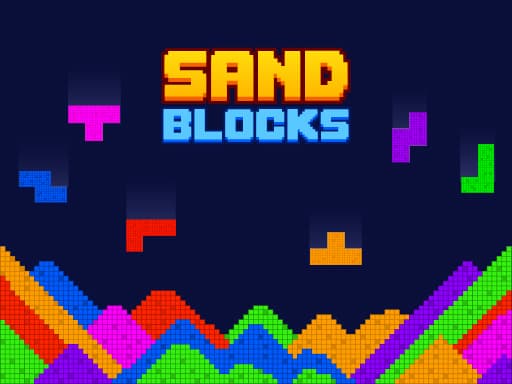
A block puzzle where each placed shape crumbles into coloured sand. Fill a full line with one colour to clear it, and keep the pile under the limit line.
Sand Blocks
Loads the game in this frame. Nothing is installed; the game runs in your browser tab.
The game is made by its developer and served through its distributor, GameMonetize. It may show its own adverts inside the frame. Read our editorial policy for how we choose what to list.
Controls
Keyboard & mouse
- Drag a shape from the tray with the left mouse button
- Release to drop it anywhere on the grid
Phone & tablet
- Touch and drag a shape onto the grid
- Lift your finger to place it
What it is
Sand Blocks takes the familiar falling-block shapes and changes what happens after they land. A placed block does not sit there as a rigid piece; it breaks into grains of coloured sand that pour downwards and sideways, filling whatever gaps lie beneath. Instead of clearing a row of neat cells, you clear a full horizontal line made up of a single colour of sand, and the game ends when the pile rises past a limit line.
The placement rules are closer to a tile-fitting puzzle than to a timed drop. You are given three shapes at a time and place each one wherever you like on the grid, in any order. Nothing falls until you place it. So this is a planning game with a physics twist rather than a reflex game, and the pace is yours.
How it plays
Control is one action: drag a block from the tray onto the grid and let go, with the mouse on desktop or a finger on a phone. The only precision problem is that the shape's final footprint will not match its outline, since the sand spreads as it falls, and a small screen makes the gap between where you dropped and where the sand settled harder to see. A tablet or desktop is more comfortable for the later, fuller grids.
Sand changes the puzzle in a specific way that takes a few games to internalise. In a rigid block game, a piece's shape is what matters. Here, the shape mostly determines how much sand lands where; once it is falling, the grid's existing terrain decides the rest. A tall thin piece dropped onto a slope will slide down the slope. A wide piece over a valley fills the valley. You stop thinking about fitting shapes and start thinking about pouring colour into low ground.
Tips that actually help
Most of what you know from rigid block puzzles is still true, and one important thing is not: colour, not shape, is what clears lines.
- Build lines by colour, not by row. A line only clears when a single colour spans the whole width, so keep colours in bands rather than mixing them.
- Drop a colour onto more of the same colour. Sand of a different colour landing in the middle of a band splits it, and a split band needs two clears to fix.
- Use the three-piece tray as a plan. Look at all three before placing the first; often the third piece is the one that completes a line the first two set up.
- Fill valleys, then flatten. Sand flows into low points, so a pile with deep gaps wastes half of each piece on places that will not clear soon.
- Keep the centre lower than the edges. Sand that lands on a peak spreads both ways and mixes into two bands at once.
- Watch the limit line early, not late. The pile rises faster than a rigid stack because sand cannot be tucked under an overhang.
The physics
What I like about this design is that it removes the tyranny of the single misplaced piece. In a rigid block game one bad drop leaves a hole that haunts the rest of the round. Here, sand fills holes on its own, so mistakes are gentler and the difficulty shifts to colour management, a more forgiving kind of hard. The cost is legibility: a settled pile of mixed sand is harder to read than a wall of tiles, and judging whether a band is one grain short takes a moment. The three-piece, place-anywhere rule keeps the game calm enough for that judgement.
Where it falls short
The developer does not mention a timer, scoring, modes or how progress is stored, so I have to assume a single mode and a best score that lives in this browser. The absence of time pressure will feel slow to players who like the panic of a rising stack. And mixed-colour piles late in a game can turn unreadable on a phone, at exactly the moment you need precision.
What works
- Sand physics genuinely changes the puzzle
- Three-piece tray makes it a planning game
- Mistakes self-heal rather than haunt you
- One-gesture controls on any device
What holds it back
- Late piles are hard to read on small screens
- No stated modes, timer or scoring detail
- Slow if you want a reflex game
Verdict
4.0Sand Blocks is the most interesting idea in this category and it is executed with restraint: one gesture, one rule change, and a puzzle that feels new for it. Play it on the largest screen you have. Skip it only if you want speed; this is a game about where colour will end up, not about racing a stack.
Questions people ask
- How do lines clear in Sand Blocks?
- A full horizontal line of one colour of sand clears. Mixed colours across the width do not count, which is why keeping colours in horizontal bands is the main skill.
- Do blocks fall automatically?
- No. You get three shapes at a time and place each one wherever you want, in any order. The sand flows after you place it, but nothing drops on a timer.
- When does the game end?
- When the sand pile rises above the limit line on the grid. That is the only end condition the developer states.
- Does it work on a phone?
- Yes; it is a single drag-and-drop gesture. Late in a game the mixed sand can be hard to read on a small screen, so a tablet or desktop is more comfortable.
If you liked this, try
 Puzzle
2048 Premium
3.5The 2014 sliding-tile puzzle with a wardrobe: 4x4, 5x5 and 6x6 boards plus Undo, Swap and Delete tools. Arrow keys on a desktop, swipes on a phone.
Read the review → Puzzle
Sokoban Master
4.0A clean take on the 1982 crate-pushing classic with undo, star ratings for efficient solutions and a level editor. Best played with arrow keys.
Read the review → Arcade
Bubble Shooter Challenge
3.0A level-based colour-match bubble shooter with bomb, rainbow and fire boosters. Competent and familiar; the boosters do most of the thinking for you.
Read the review → Puzzle
Gem Mahjong
3.5Mahjong-solitaire matching rebuilt around a slot tray and a timer: pick a free gem, find its twin, and never let the tray fill. A phone-first portrait game.
Read the review →