What makes a good puzzle difficulty curve? A game developer's view.
A mobile puzzle developer on safe first levels, the aha moment, plateaus versus spikes, timers, undo and stars, tested against sudoku, sokoban and 2048.
Difficulty is the thing players complain about most and describe worst. "Too hard" usually means "I did not know what to notice", and "too easy" means "nothing surprised me". The puzzle games my studio makes live or die on their first twenty levels, so I spend a great deal of time on curves. This is what I believe about them, with the classic browser puzzles as evidence.
Teach the rule with one level you cannot fail
The first level has one job: to make the player perform the rule without being told it. Not read it; perform it. A tutorial pop-up is a confession that the level failed. You build a safe level by removing every alternative, one crate, one target, one corridor, so the only legal move is the right one and the player feels they discovered it. The craft is making it feel like a level rather than a lesson, which usually means allowing three or four moves rather than one.
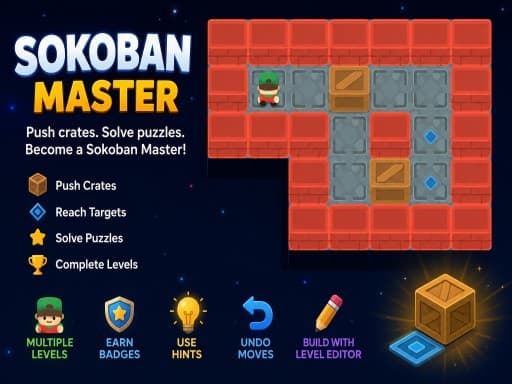
Sokoban is the model. Its rules fit in three sentences, and the format allows a first level where the only reachable crate has one open side; Sokoban Master opens with a beginner tier, which is where that level belongs. Sudoku has no equivalent, because there is no sudoku you cannot fail: the rule has to be read. Sudoku: Classic Minimalism simply states the three rules, which works because nearly everyone arrives already knowing them.
The aha level has to arrive early
Every rule has a consequence it does not mention, and the level where the player discovers it decides whether they stay. In sokoban it is the crate that goes into a corner and never comes out. In minesweeper it is the first time two numbers together prove where a mine is. In 2048 it is realising the big tile must live in a corner. I want this aha inside the first five levels, because after that the player has settled into a rhythm and a surprise starts to feel like a betrayal rather than a gift.
The aha should be losable and cheap: the player makes the mistake, sees the consequence, and tries again within seconds. Minesweeper: Find Bombs gets this for free, since a wrong click ends a board that took a minute. A game where the aha costs ten minutes of progress teaches players to hate it.
Plateaus keep players; spikes lose them
After an aha you want a plateau: three to five levels at the same difficulty that let the player use what they just learned until it feels like theirs. Designers dislike plateaus because they look like padding on a spreadsheet. Players love them and call it getting good. What players notice is the spike, a single level far harder than its neighbours, and the level-by-level completion funnel of any puzzle game shows a cliff exactly there. The fix is rarely to soften the spike; it is to add the missing plateau before it.
Nonograms make plateaus easy to build because difficulty is legible in the grid: a small grid with several full lines is one step, a larger grid with none is several. Simple Nonogram puts the calm in its title and states that time is not limited, the right posture for a game whose appeal is deduction.
Timers are difficulty by taxation
A timer does not make a puzzle deeper. It makes the same puzzle less pleasant and moves the challenge from reasoning to speed, which is a different game. Designers add timers when a level is not hard enough and a properly harder level would take a week to build. I have made that trade and regretted it. The exception is when time is the mechanic rather than the tax: the clock in the Bullet and Blitz modes of Elite Chess is the point of those modes, and players choose them knowing it.
Gem Mahjong runs each level against a clock but gives you levers, four power-ups and two unlockable slots for when the tray gets tight, that buy back pressure. That is a timer used honestly. The dishonest version sits on top of a logic puzzle and turns a moment of thought into a penalty.
Undo is a design decision, not a mercy
Whether a puzzle has undo changes what a level is allowed to be. With unlimited undo, a level can demand experimentation: try, see, step back, and the puzzle may hide its structure until you poke it. Without undo, every level must be readable from the start, because a wrong move is a restart and players will not forgive a puzzle solvable only by trial. Sokoban belongs in the first camp, and Sokoban Master's unlimited undo is correct. Minesweeper belongs in the second: a click is a commitment, and undo would dissolve the game.
The interesting case is 2048 Premium, which offers Undo alongside Swap and Delete as power-ups below the board. Making undo a power-up rather than a keystroke tells players it is precious, and they respond by planning more and gambling less. Whether that is better depends on whether 2048 is a planning game or a flow game. I lean towards flow and would rather have free undo or none, but it is a defensible choice, and the point is that it is a choice.
Stars are a second curve hidden inside the first
A star rating lets one level serve two players. The completion threshold can be generous, so nobody gets stuck, while the three-star threshold carries the real difficulty for those who want it. It is the cheapest way I know to widen a game's audience without writing two sets of levels. The failure mode is an arbitrary star condition: a move count nobody could deduce, or a time that rewards a lucky bounce.
Sokoban Master ties stars to move count against a known optimum, which is the good version: same level, fewer pushes, a real second problem. A stunt game like Crazy Moto stars you on time, honest for a game about throttle control. In my own games I avoid stars for collecting things, because collecting is a tour, not a puzzle.
How the classics do it
Each puzzle people have played in a browser for twenty-five years answers these questions differently.
- Sudoku: the curve lives in the generator, not in level order. A hard sudoku is not one with fewer givens but one that needs deeper techniques, and a good generator grades by the hardest deduction required. No timer, trivial undo, no stars, because there is one solution and one way to have found it.
- Sokoban: hand-made levels, curve by ordering, aha through corners and order dependency. Undo is essential; stars by move count are natural because the optimum is knowable.
- Minesweeper: difficulty by mine density and grid size, no undo, no stars. Its unresolved flaw is the forced guess, a fifty-fifty the board cannot disprove. Guaranteeing a safe first click fixes the start; nothing fixes the middle.
- Nonograms: difficulty by grid size and by how many lines resolve immediately. A well-made nonogram never needs a guess, and a maker who cannot promise that has not finished the puzzle.
- 2048: no levels at all. Difficulty emerges from a crowded board and the only lever is grid size. 2048 Premium labels its 5x5 and 6x6 grids advanced and expert; more room makes any single merge easier to set up, so what climbs is the length of a game and the number of tiles to track, a different kind of hard.
What this means for the games I make
In the puzzle games my studio makes, the first ten levels are rebuilt more often than everything else combined. We put them in front of people who have never seen the game and watch for two moments: the first time they stop and think, and the moment they put the phone down. The first should come early. The second should not exist, and when it does, the answer is rarely to ease that level; it is to ask what the three before it failed to teach.
Questions people ask
- Should a puzzle ever need a hint to finish?
- No. A hint is a repair for a level that failed to teach. Hints are worth having because players arrive tired or distracted, but if testers reach for one on the same level repeatedly, the fix belongs in the levels before it.
- Is a difficulty setting a substitute for a curve?
- It is a different tool. A setting asks players to know how good they are before they start, which they rarely do; a curve finds out by watching them. Modes such as the three grid sizes in 2048 Premium or the timed modes in Elite Chess work because they change the game rather than scaling it.
Games mentioned in this guide
 Puzzle
Sokoban Master
4.0A clean take on the 1982 crate-pushing classic with undo, star ratings for efficient solutions and a level editor. Best played with arrow keys.
Read the review →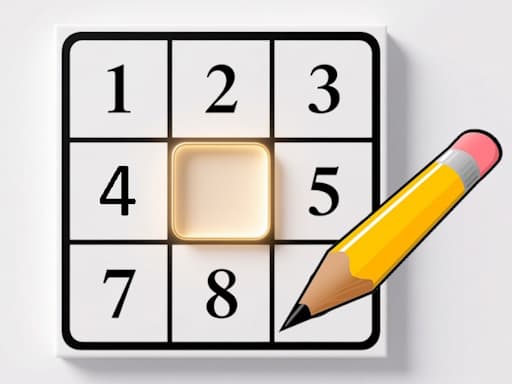 Puzzle
Sudoku: Classic Minimalism
3.5A no-frills 9x9 sudoku built for a phone held upright. The rules are the standard three and nothing gets between you and the grid. Good for a quiet break.
Read the review →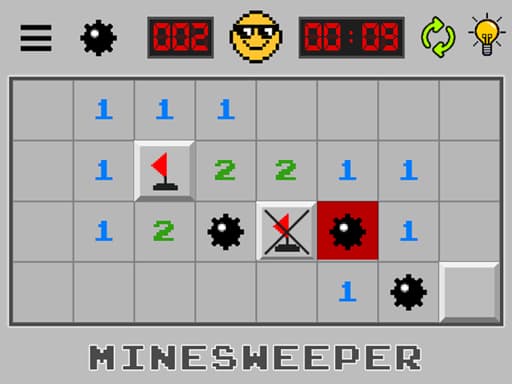 Puzzle
Minesweeper: Find Bombs
3.5A Godot-built minesweeper that swaps the classic board-size picker for a run of levels. Left-click opens a cell, a long press flags it. Best played at a desk.
Read the review →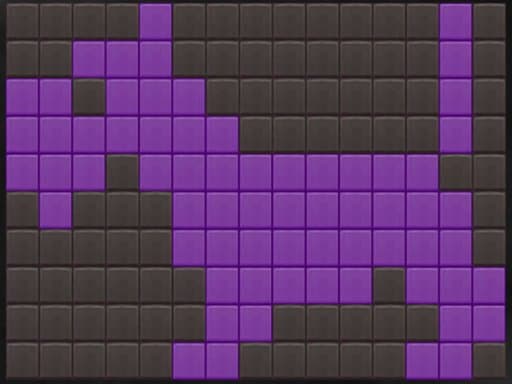 Puzzle
Simple Nonogram
3.0A bare-bones picture-logic puzzle: fill cells so the row and column counts line up and an image appears. No timer, no clutter, works with mouse or touch.
Read the review →Keep reading
- explainer
How we review browser games
The exact process behind every review on this site: where the games come from, what gets one rejected, what each section means and how a rating is decided.
- list
Nine browser games that fit a ten-minute break.
Nine reviewed games chosen for round length, quick starts and how easily you can stop: minesweeper, 2048, solitaire, ping pong, mini golf and more.
- explainer
What is an HTML5 browser game, and why does it need no download?
How a game runs inside a web page: canvas and WebGL, engines like Unity and Godot, why the first load is slow, and what a browser game cannot do.